

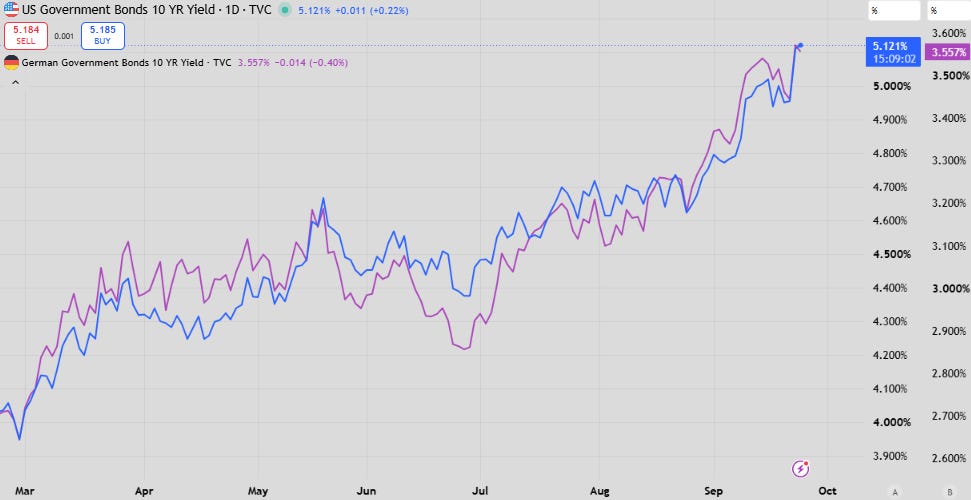
I was planning this piece before the shank in bond yields on the 23rd. After that session which saw the US 10-year up ~16bp and Bunds up ~13bp, I guess more people will be asking the same question as this edition of Charts & Notes poses.
The summary is that:
The bad news is that there really isn’t a reason for the sell-off to stop;
The only way it could is if the Fed/ECB guided to a few hikes only;
This means that the long end just won’t rally, but bull steepeners are the “bullish bond” play; and
The out of consensus view is that it just doesn’t matter to risk assets at all.
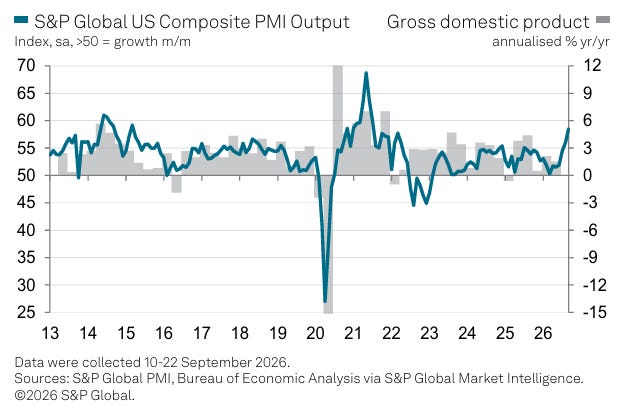
Headlines of a potential US diesel export ban seems to have explained the intensity of the later move throughout the session, but for me the sell-off started with the release of some super PMI data. That ignited the fire and then it was doused in diesel, as it were.
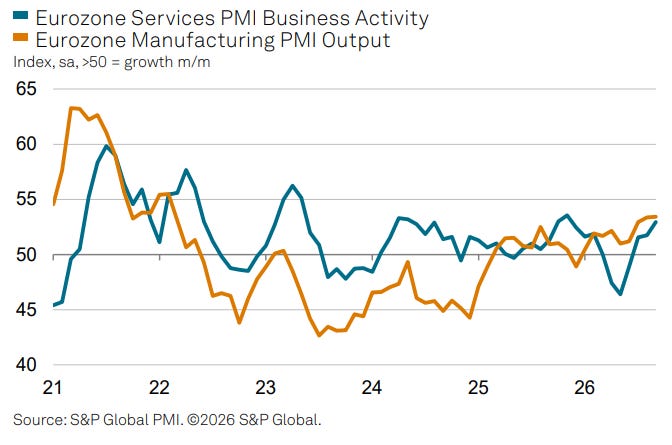
This was particularly bad for Europe, but the US yield curve priced in the real effect a diesel ban would have which would be rising gasoline and jet fuel prices as refineries reducing runs would affect the availability of all products, not just diesel.
I don’t think the ban will be enacted in a broad form. There is little benefit for much cost (including making things worse with Europe for no domestic gain).
So, the sell-off in bonds is from a good news story of higher growth and resilient economies, along with the continued inflationary pressure of refined product pricing. We’ve had high diesel prices for a while due to Hormuz but the constant destruction of Russian refining capacity by the Ukrainians is adding a much less temporary angle to the problem.
I’ve written about these trends before so none should be a surprise to regular readers.
On why real yields should be higher (the growth story):
Real yields should be higher

So, I got up at 4am to hear the new guy at the Fed speak at his first live meeting. Was it worth it? I’m a huge fan of moving away from the post-GFC hand holding of forward guidance, but taking this away obviates the need for 95% of the communication schedule that the Fed used to run in the forward guidance world.
And on inflation and initiation of short bond positioning:
Oil doesn't matter; do rates?

Last week’s US Producer Price Index (PPI) print in the US finally got me off the fence on bonds again. I sold a third of my max risk across the US, UK and Europe, looking to add more on a bounce. It didn’t take long but the 10% rout in crude (and a soft UK CPI) has already given me another look at it.
I’ve covered these trends enough to avoid repeating them here. Today we get to ask whether this can ever end.
“Priced in” with quotation marks
Potential export bans and the left tail of not only diesel pricing but potentially availability encourage a market that sells first and asks questions later. There just is no “priced in” with a market with these characteristics.
Similarly, growth is only improving without a perceptible effect of the war. Nobody believes that a recession is around the corner, and this is supported by one of the most incredible outcomes I’ve seen in markets; an entire FOMC board that thinks the same.
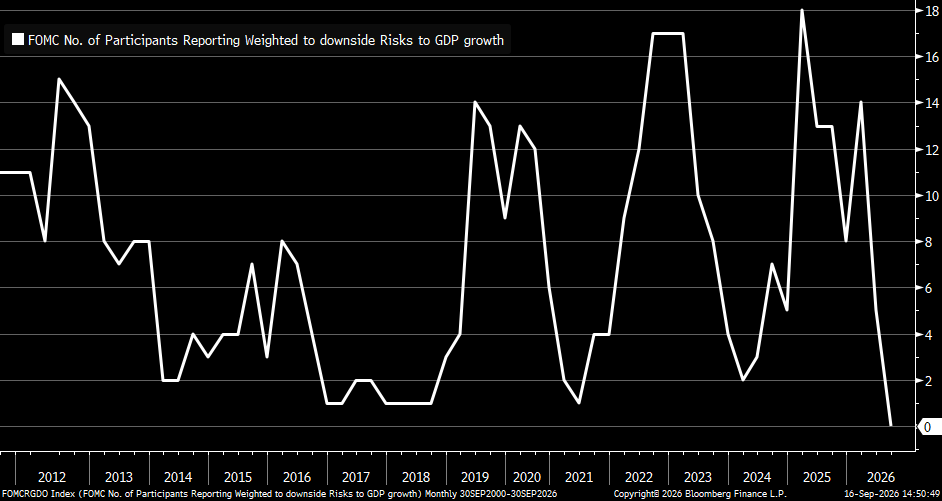
I don’t think this is worth fading at all. They’ll probably be right. Along with strong PMIs yesterday, GDP tracking models are at 3.5%+, with Atlanta Fed GDPNow at 5.1%!
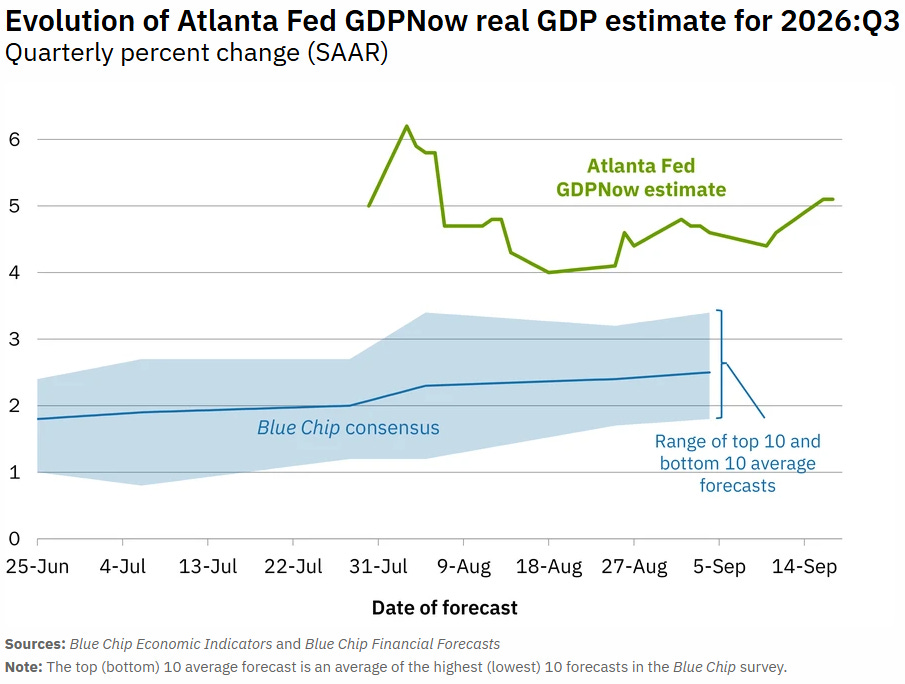
Inflation is a worry but isn’t driving these markets.
If the question comes to when this is all “priced in” I really can’t give that answer while growth is on the trajectory it is. Expectations were low into the middle of the year given that most thought the Iran situation would cause growth to slow. It clearly hasn’t.
These expectations need to be adjusted. While many are panicking about the headline yields (“Bond Meltdown” as Bloomberg reports), curves have been flattening as the primary reason for the bond sell-off has been that pricing for central banks went from cuts driven by softening inflation to hikes driven by war inflation and extreme AI capex acceleration.
This has meant that curves have flattened as the rise in short end yields outpaced that at the long end. This was never a bond rout.

That first chart, Dec-27 SOFR vs 10-year now looks like this.
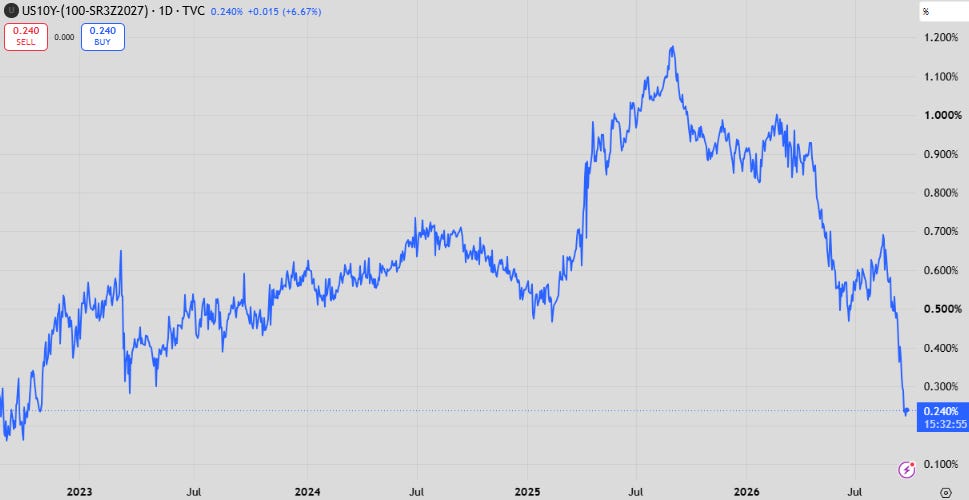
It has flattened another 25bp (!) from the early September X thread linked above. That’s insane.
Interestingly, last session saw this steepen a little along with other spreads that have denoted that these hikes might be lasting a little longer than the next year.
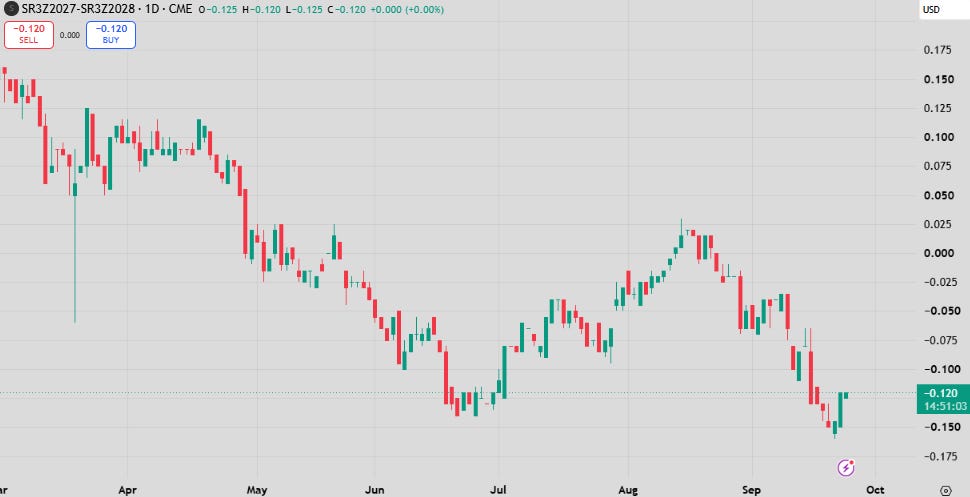
The Dec-2027/2028 SOFR spread above was moving more negative as curves flattened (i.e. the market was expecting more cuts in the 2028 year). The move last session is seeing a reversal. This indicates more of a steepening pressure along the curve.
I think the flattener has finished its run for two reasons. There is a heap priced in for the Fed/ECB and they really can’t get flatter without a growth scare.
The 10-year can’t rally, but <5y definitely can
I don’t think calling for a broad fixed income rally is possible for the dual growth and inflation reasons above.
The growth backdrop eliminates the potential for curves to flatten much further. The amount priced into to central bank paths is also quite substantial making front-end driven flattening a tough ask from here.
Offsetting this is there being plenty of room for the 10-year to continue selling off from here. If we are in a genuinely 3.5% growth + 3% inflation environment, then 10s at 5.1% aren’t value.
Can hiking expectations drop? Maybe, I’m not sure what the catalyst would be. But this is clearly where the possibility of a rally lies.
Outside of the domain of rates traders, is a 10-year at say 5.5% a bad thing for equities? My answer would equivocally be no, but we all know the market won’t necessarily take it that way. This makes the game one of buying the dip when fear is at its worst, which you would probably classify as today as at least an example of one.
The capex boom should push yields higher over the next few years, but AI-driven R&D could raise the long-run productivity growth rate itself. Anthropic’s wet lab and OpenAI’s Navier–Stokes solution already demonstrated that potential. If AI ends up being more like the 1600s Scientific or 8,000 BC Agricultural Revolution than the Internet or smartphone revolutions, productivity growth could settle at a permanently higher rate even after the capex boom and AI diffusion are over. We may simply never see sub-4% long-end yields again.