

I won’t spend long going through the numbers. WTI/Brent up nearly 20% on the month, first Brent print over $100/bbl in a while.
Some of this is “war premium” or the premium demanded by the market for the daily risk of escalation which is higher now than at the end of August.
Attacks are nowhere near as bad as in March where nobody knew what to expect. Yet front-month oil futures pricing is approaching the worst of those times.

The spike in physical barrels over paper benchmarks is another that has picked up since the worst of it in March. Something has changed here, and the accepted reasoning is that Chinese refiners are competing amongst themselves for loadings.
Once again, we are in the same position that caught out so many in March and April. Physical pricing never pulled futures pricing up to its lofty heights, and the gap collapsed well before paper pricing did.
When forecasting doom goes wrong

If Donald Trump and Scott Bessent were President and Treasury Secretary in 2008, would Lehman Brothers CDS have ever traded over 150bp?
Learning lessons from the mainline newsletter above, let’s collect our thoughts before we run away with bearish sentiment again.
Rule #1: China still has the incentive not to buy
China’s reserves have permanently changed the oil market previously led by supplier surpluses/deficits to one driving by the demand side. I think this one fact is what caused the entire community of oil analysts to get things so wrong this year.
The current rally in oil prices has been partially explained by how consensus has moved back to China being “back” in regard to buying crude to try and close their deficit and reliance on onshore inventories.

There has been a bounce in imports based on the chart in the post above. It is worth remembering however that Brent averaged $87 during August, with an early month low of $78. Stories at the time suggested that African and South American loadings were going uncontested.
This suggests a tightening consistent with the price rises we’ve seen, but the relevance for broader risk appetite is whether this tightening manifests itself in genuine shortages. If China can decide whether this will happen or not, it won’t happen.
It still stands that China is importing 3-4mmbbl less that it did before the war started. As we’ll see in rule #2 this probably covers the entirety of the Hormuz deficit and thus leaves the market in balance.
I’m very doubtful that they will keep buying to propel Brent much past $100/bbl. Why?
They have no incentive to choke off crude to their Asian neighbours. Doing this would be more damaging to China’s economy than for the US.
They don’t need to pay >$100/bbl with such large reserves being drawn at a fairly reasonable rate.
While China does consider the US an enemy and it supports Iran on this basis, the two countries are not ideologically aligned. The Chinese economy is far more important to China than Iran’s status post-war.
These are listed in order of importance. The first reason around their neighbours is most important since this is the existential risk is that economies can’t get the crude they need, with the distant second being the price they get it at.
China will not crowd out their neighbours. The damage to itself will be greater than the damage that would do to the US.
Rule #2: More oil is getting through Hormuz than we know
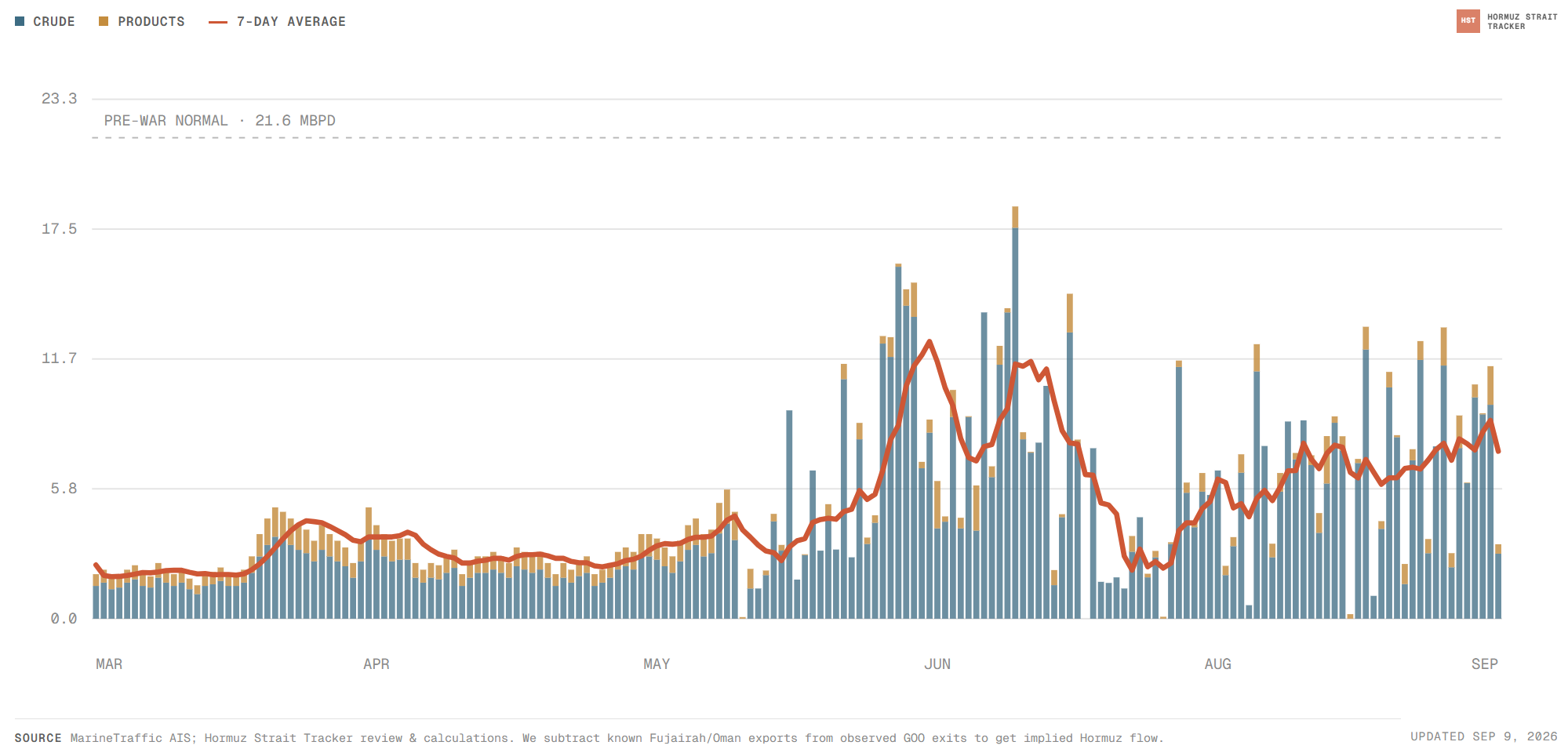
It is amazing that X user @phileeppos managed to outclass all the big “barrel counters” by developing a way to count transits through Hormuz by noting transponder pings inside and outside the Gulf instead of trying to track them through Hormuz itself. This methodology has subsequently been picked up by the industry leaders like Kpler etc.
This methodology has put average transits at around 7.5mbbl/d. Add in other workarounds and transits and it’s not far from where we were pre-war. Warship escorts have worked to a certain extent.

These numbers match the stated flow difference using the methodology above and the fall in production throughout the gulf. Taking away the amount China bought to increase her reserves leaves an error that is likely in the 1-2mmbbl/d range. These amounts won’t deliver the broad bearish case of spotty crude availability.
Port loadings in the various gulf states indicate even more flow than this. Ask yourself, when was the last time you heard about production being shut down because storage was full? It’s been a full 6 months since the war started and we would’ve expected storage to fill by now.
Refined product is still under severe pressure, but broader risk markets seem to really only care about crude itself.
Rule #3: Iran can’t shoot the hostage
While talk and shitposting on X is full of bravado (on both sides), Iran’s constant threats to destroy Gulf oil infrastructure still hasn’t happened. Even tanker attacks are sporadic. The attack on a Panama-flagged tanker in Iraqi waters today upset markets, but what sort of reaction is this to the US sinking 9 or 10 Iranian tankers this week?
Iran is playing the game like it is itself a superpower, using deterrence rather than proactively causing crude shortages which would entirely be within its ability.
Given rule #2, it also seems like they either can’t or don’t want to stop Hormuz flows.
It’s pointless to speculate why. Perhaps current leadership just wants to survive and are hoping that price pressure and sentiment is enough to derail the US without causing any real shortages. Perhaps China tells them not to. Either way they just aren’t inflicting the damage they are likely capable of.
Iran seem to be happy to shoot at US bases and warships rather than anything that will reduce the physical supply of oil. This seems odd, doesn’t it? Shooting at warships doesn’t really help Iran win this war.
Either way, Iran is acting against what many (including myself) thought they would do when provided with this opportunity. Time to adjust your priors if demonstrated behaviours don’t match it.
Rule #4: Never forget that things were worse in March - escalation risk needs constant aggression to be maintained
Have inventory buffers been depleted since the war started? Absolutely. It’s estimated that the world has lost about 1.5 billion barrels which has been made up through reserve depletion.
Does this leave oil more exposed given that reserves have depleted this much? No, not yet anyway. Eventually it will, but buying is still optional at this point in time.
It’s here that the doomerism is the strongest. The biggest fearmongers relating to forecasts of “tank bottoms” have been and gone so many times they don’t really even make any forecasts anymore.
The escalation threat by both sides was more credible in March. Today it is not comparable at all. It’s been a while since we had daily tit-for-tat, and escalation risk should be priced in, but after 3 or 4 days of nothing it will wear away again.
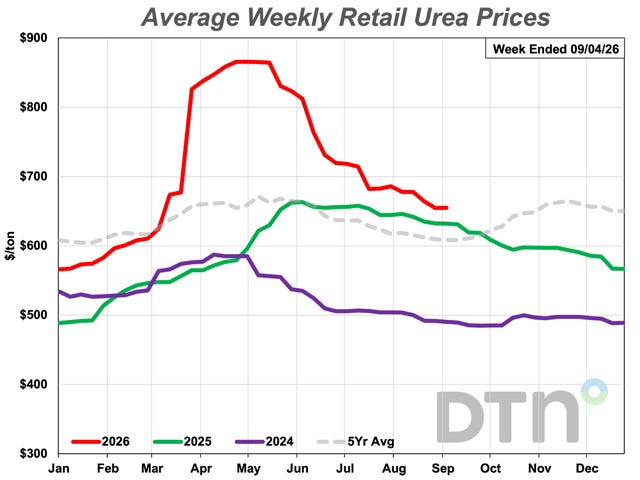
Other bearish angles like the price of fertilizer are actually back to just above pre-war. Seems impossible that this is the case, but such is the problem with having such a bearish base case for everything.
Rule #5: Don’t speculate on how the war will end, if it ever does
This is where you have to control yourself and not be the armchair geopolitical expert. Not one person I’ve followed has got the trajectory correct in terms of the face-off between the US and Iran. Don’t get caught in trying to predict it yourself.
Nobody knows the pressure that the blockade is inflicting on Iran. Nobody knows how determined Trump is to get his way, or whether he even cares about the midterm elections at all.
We don’t know, and that’s ok. Inflation will be a problem, as will bond yields. Sentiment will wax and wane around escalations turning the market into an on-off switch that constantly crashes up at signs of de-escalation.
For the same reason it’s not worth worrying about sovereign debt after the Euro crisis, it isn’t worth worrying about oil after Hormuz.
For the same reason this blog is called Macro is Dead, the governments of the world have solved another problem that had potential to stop the wheels spinning.
In this case, they’ll just accumulate more debt and burn through reserves to stave off any collapse. If Iran escalates (which I don’t think they will) then the US has a chance to shift costs to the future by abandoning its security guarantee on the Middle East in a move that would permanently embed geopolitical risk into the oil price.
More debt, more interest cost, more inflation. What problem can’t be solved by just accepting more of those 3 things?
A masterclass in a few minutes of reading.
best in the biz
great writers work hard so the reader doesnt have to