

As a young trader, I remember getting a call on late one Friday afternoon in September 2008 offering short-dated senior Morgan Stanley paper for around 40c in the $.
The size wasn’t huge, so I countered for 35c and got filled. The seller must’ve been very motivated.
Come Monday, my boss raked me over the coals for that trade, even though Morgan Stanley survived that weekend and the bonds were immediately revalued at double the price we paid for them.
Did I get lucky? Definitely. There was nothing about Morgan Stanley that made it any more important and worthy of being saved than Lehman Brothers.
So, was the purchase of those bonds poor risk management (as my boss attested) or was I actually buying them cheap for the amount of binary risk present? We’ll never know the ex-ante probability of that default because we only know one outcome - where Morgan Stanley survives. The probability function collapses and there is no way to observe the “true” probability of default.
This is the main reason people hate binary outcomes so much. They are hard to diversify and after the fact an honest trader won’t be able to determine how much was luck and how much was skill.
They also spike volatility and then crush it. You’ve got one chance to make or lose a whole lot of money and then that’s it.
After Monday’s Truth Social post and one of the biggest single candles I’ve ever seen we have settled into the hated binary outcome market. Does the war end (even temporarily) or not?
Governments and the binary market
The story above about the Morgan Stanley bonds challenges the idea that we are in a unique period of binary outcomes with Trump’s random tweeting.
The truth is that these binary outcomes have been present in every crisis because we expect our governments to manage volatility during these times.
Whether banks lived or died during the GFC fell to the arbitrary decision of regulators. Whether TARP (the Troubled Asset Relief Program, designed to remove toxic assets from bank balance sheets) would pass congress or not (to make things even worse it didn’t pass and then did, but only when markets fell too much!). Sure, it didn’t get expressed by tweet, but the same arbitrary decision making remained.
The traders who said “there is no way they are going to shut the global economy down” before the pandemic are using the same rationale as those that believe that there is no way the war will continue because the effect of blocking the Strait will be too much for the global economy to bare. This isn’t a judgement of these traders at all…it’s a valid expectation. The first just didn’t happen to be right because politicians chose otherwise.
These binary outcomes generally happen when there is one decision maker in control. Whether it’s King Trump or Congress (who move in a herd anyway) the binary effect on markets is no different. It’s just as difficult and just as tiring.
This ties into a previous piece I wrote about how intrinsically the government is tied into these outcomes because the amount of outstanding debt in the economy (both public and private) forces volatility management and makes them much more important than they otherwise would be.
Low interest rates don’t drive up asset prices – governments do

Macro-economic data shows that debt accumulation by the private sector has little to do with the level of interest rates. This suggests that it is not low rates that are the dominant driver of asset prices, but the success of continual economic intervention by governments and central banks instead.
The binary outcome we are faced with
We know the market hates this type of uncertainty with the trading range bounded strongly and small in size despite elevated implied vol.
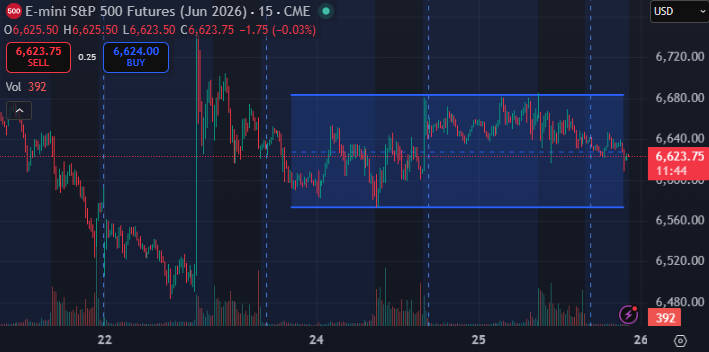
Participants prefer not to play by initiating new positions and just keeping their old. You can minimise regret that way. Many will just move enough to try to get to flat so that they have no exposure either way.
Getting back to flat without liquidating is tough as well since different assets will have behave differently depending on the outcome. You might be perfectly hedged in a “war continues” outcome but drag heavily if there is an end to it, or vice versa.
There is also the notion of carry (or negative and positive theta) to consider here as well. In this crisis it works in both directions.
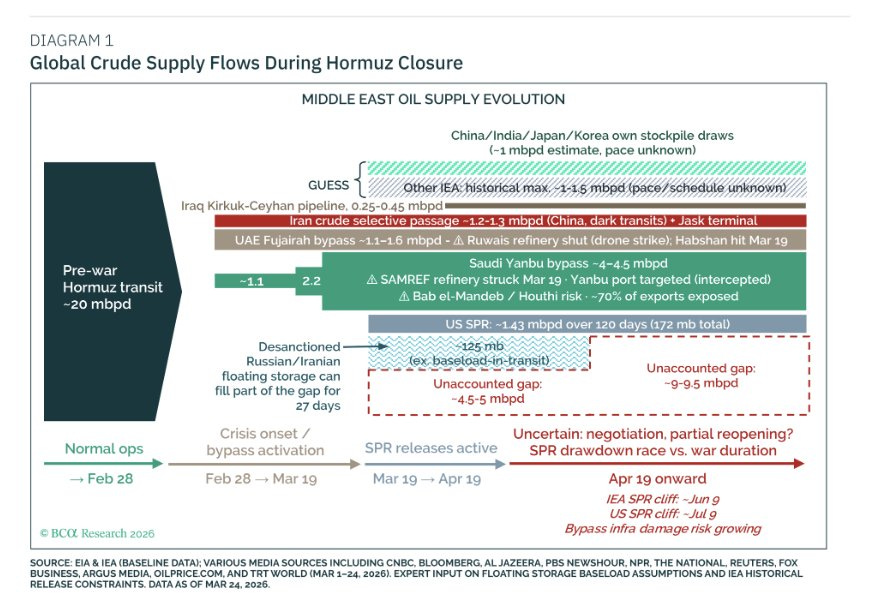
Every day that the Strait is shut, there is an accruing amount of damage to the global economy. This is negative “theta”. Absent a resolution of the binary outcome, the risk neutral level for whatever asset should be shifting every day. For bonds it means a drag higher in yields as the market wants to price more hikes the worse the crisis gets (for the time being as this could flip). For equities, the level should be further down as the crisis drags on.
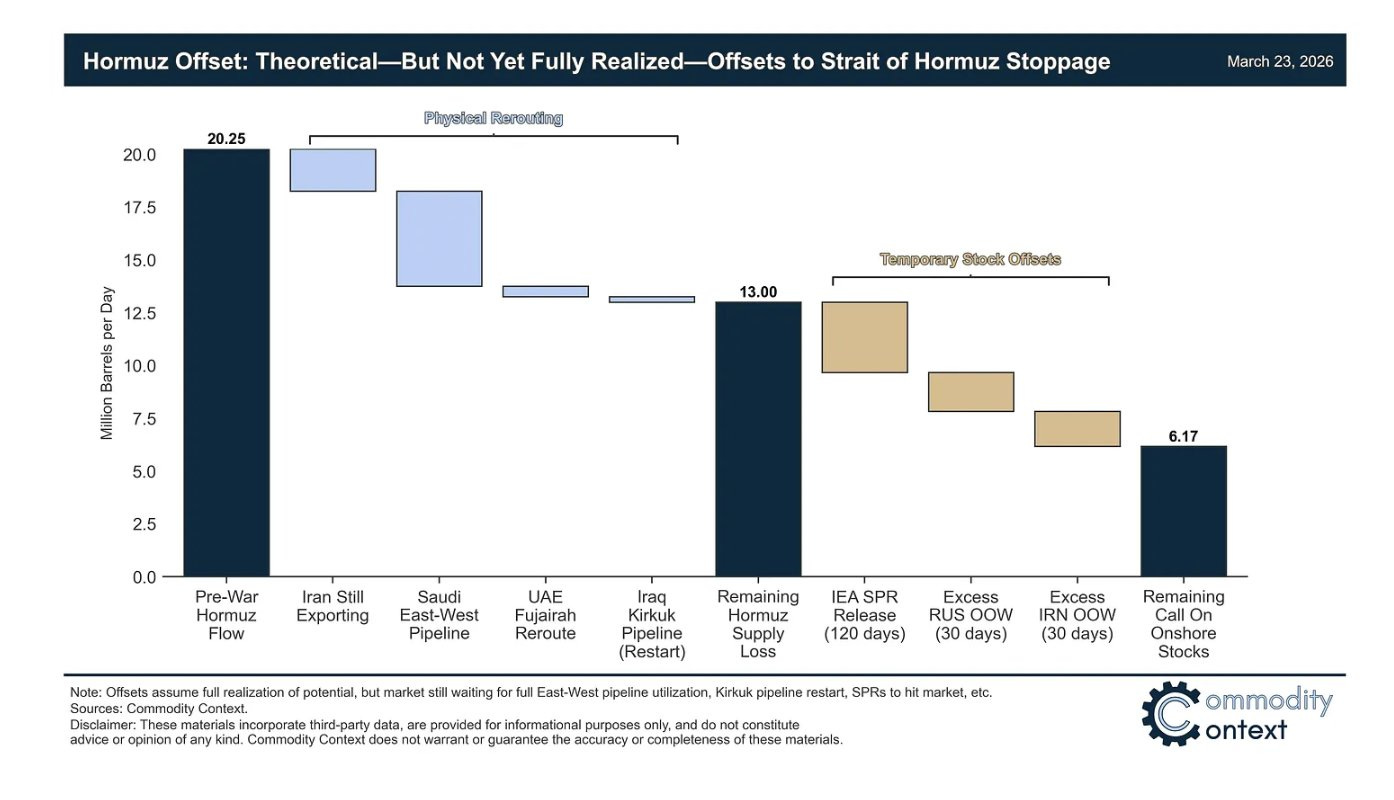
The same applied to the GFC. The longer it dragged on without resolution, the worse the effect on the economy. The pandemic worked in the other direction, but the market kept falling as the probability of the shutdown increased.
There is a positive carry element too. US equities still have earnings that are growing at 20%+ and the market has been flat for more than 6 months now. The negative carry of the oil problem probably outweighs this.
The gap between good and bad outcomes also increases by the day, increasing the volatility on resolution of the binary outcome.
Investors like outcomes to fit into historical probability distributions
The title of this section is a very fancy way of saying that investors just want their assets to behave like they have in average over the past.
Nearly every professional investment process is based on the idea that assets will perform in the future like they have in the past, whether quantitative or qualitative.
This is the main reason for why market participants find it so hard to stomach binary outcomes. A “normal” market has such cool, predictable features as:
Momentum
Mean reversion
Sort of log-normally distributed returns
These are not present in a market with some sort of binary-shaped distribution.
Markets exhibit these features because the underlying economies/companies act like wave functions. Recessions and recoveries happen slowly. Company earnings exhibit momentum. Stock prices and bond prices reflect the fact that the underlying drivers are also continuous functions.
There is also the problem of trying to predict when and to what that distribution changes to.
If an asset isn’t going to perform like it has in the future, then how will they possibly act? And if you manage to guess it right, you’ve lost every other time you’ve tried to predict that change.
It’s too hard and too uneasy. Real-life just doesn’t work that way. Gains and losses are incremental and build over time. They also average over millions of people. There is no reason we should be left with perpetually shifting return distributions when the normal one reflects real life in modern ecnomies.
What happens in Iran
Enough about how uncomfortable the current situation is. What will happen?
Short answer is that nobody knows, least of all me. Everyone is lying, as each party has the incentive to lie. Trump will lie because it keeps the oil price down. Iran will lie because it wants the oil price higher.

The post above summarises it well and I would generally agree but gives no answers.
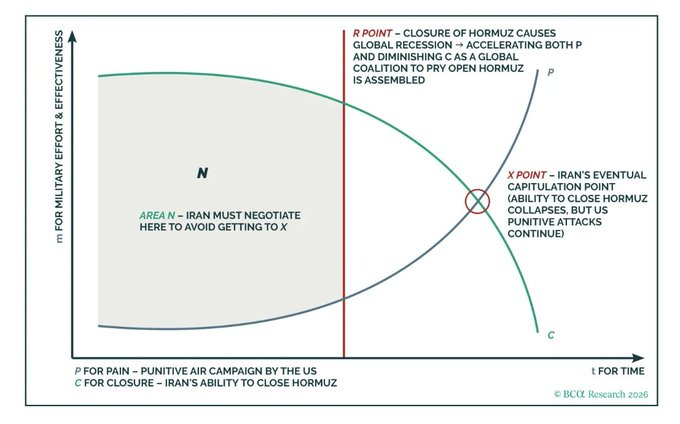
The conceptual chart above from BCA reflects the same idea. Whether Iran cares at all if the entire globe is against them is yet to be determined.
Agreeing to ceasefire also means that Iran can’t force shipping to pay tolls since they can’t fire on commercial vessels (which would obviously break the ceasefire) and would result in an open Strait. Such a deeply binary outcome for Iran as well.
It remains to be seen how much Iran will push for its pound of flesh. Allowing it to keep the tollbooth would undermine free and unfettered transit and would be a serious blow to US hegemony due to that being the entire point of the US having such a dominant navy.
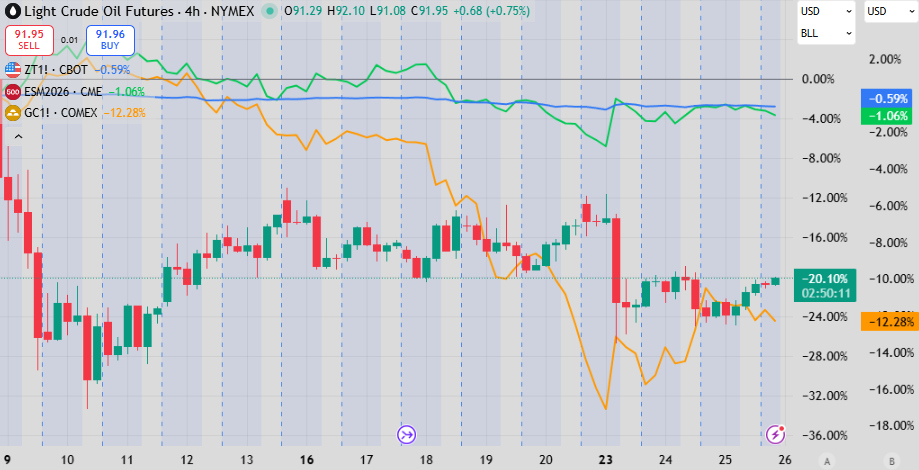
With the move of oil to below $90/bbl this puts basically every single macro asset in drawdown since it peaked. Equities in some places might be flat (Europe), but bonds are definitely down along with gold and most other commodities. This is after the Trump “we’re negotiating!” post.
Correlations eviscerated. Portfolio theory blown up. I’m short equities and it is very uncomfortable.
Binary markets often show up when liquidity becomes the primary transmission channel instead of fundamentals.
When financial conditions tighten or ease quickly, positioning adjusts faster than earnings expectations can.
It makes markets look headline-driven on the surface, but underneath it’s usually a regime shift in liquidity.
Feels like we’re still trading that channel right now rather than a traditional growth cycle.
Thanks Peter, always interesting notes. I'm with you on short equities, trying to identify what assets have not corrected enough vs those that have corrected too much on forced positioning squaring. I running short spooz vs long SFRz6 at c.3x hikes priced for 2026. if the Fed get anywhere near realising vs whats priced US stocks will have to price lower (in the current context and without a miraculous zero impact on econ growth/jobs). A swift resolution will see the hikes taken out pretty quickly which will hedge the prem loss on the ESm6