

It’s been a long time between drinks for the US intervening in the Japanese Yen.
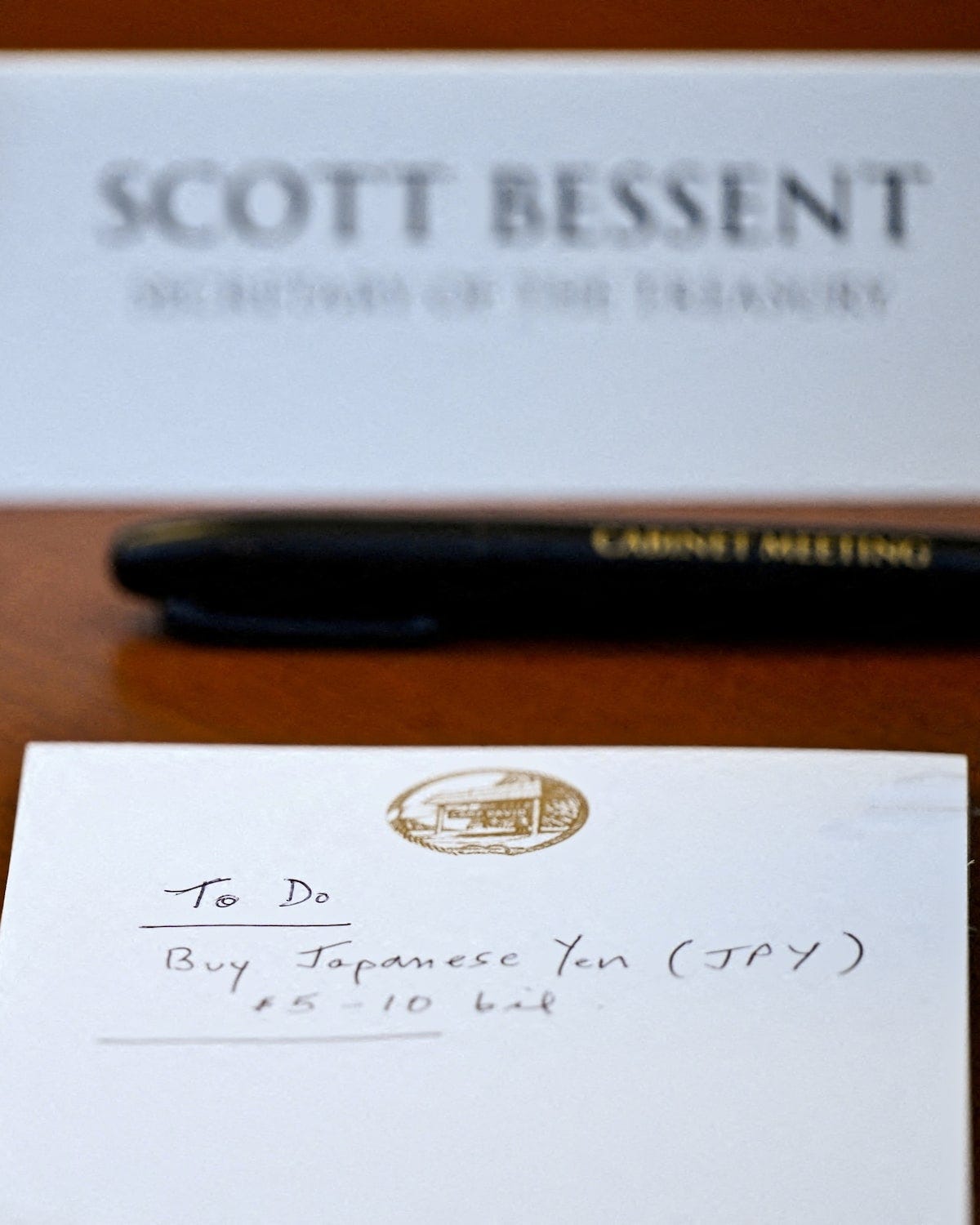
The US (through EUR/JPY, as opposed to selling USD directly) is estimated to have sold around the amount written in the conveniently placed note above.
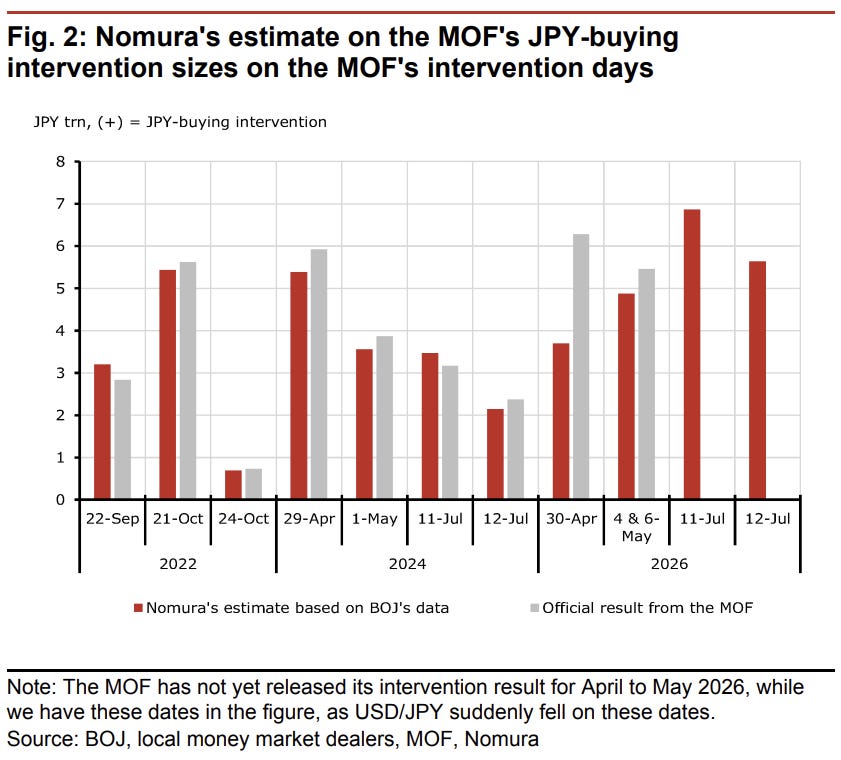
This was in addition to roughly $88bn (or 14trn Yen) in intervention firepower from the Japanese MOF as well, an amount likely higher than April & May interventions.
These sorts of events really hit the bingo card when it comes to selling doom. Countless articles detailing how intervention is necessary to stave off collapse of the Japanese economy, how without intervention there would be mass liquidation of US Treasuries that would follow an unwinding of the “Yen carry trade”. To them, co-ordinated intervention is proof that the system is very close to collapse.
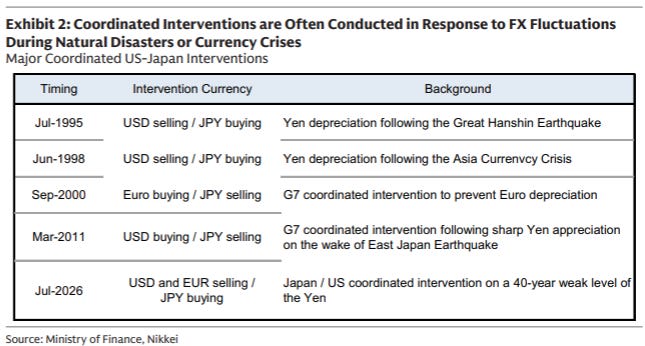
Even Treasury Secretary Scott Bessent himself spoke about how the 1998 Asian crisis starting with a weakening Japanese Yen that would cause a ripple of competitive devaluations across the region. Talk about fuel for the fire.
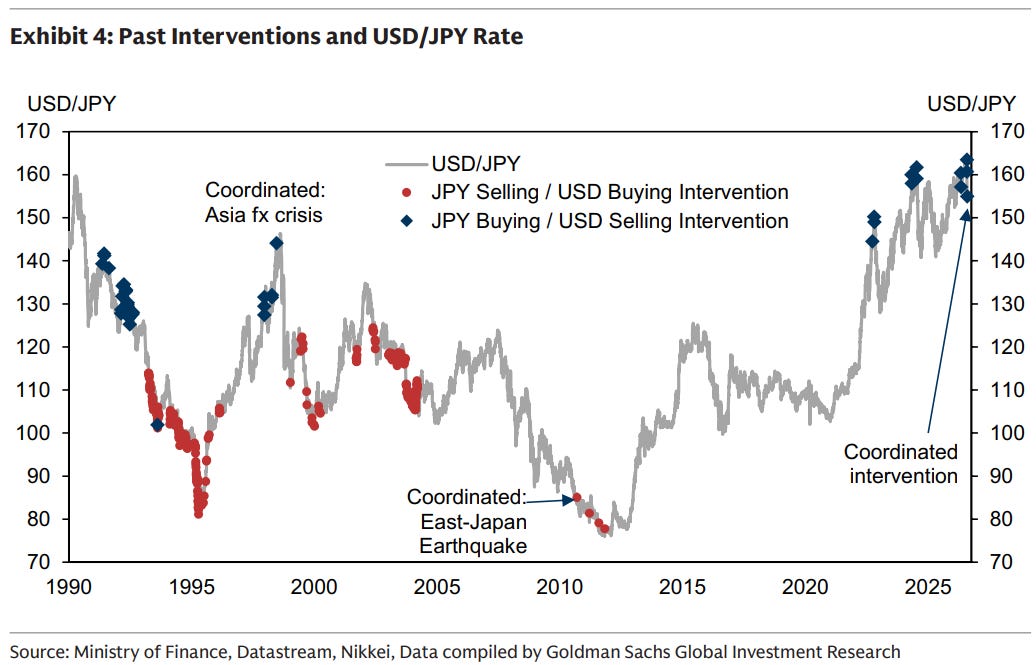
I can say with certainty we aren’t in the same environment that caused the late 90s Asian crisis. That crisis was a problem of currency pegs encouraging too much foreign currency borrowing without central banks having enough foreign reserves to defend pegs if confidence was lost. Today Asia is the exact opposite. China is such a huge force and has an unbreakable currency.
It always is hyperventilating from a media and influencer cohort that treat anything interest rate and FX related from a faraway economy as existential.
The real reason? The Japanese want their cake and to eat it too. They want highly reflationary policy and to not raise interest rates.
I know it’s boring, but this is it. The world economic and market systems do not rely on the Yen to trade at a particular level. Further devaluation won’t be existential.
However…if intervention wasn’t happening, it is likely that Yen devaluation would accelerate. It isn’t going to destroy the world through the carry trade and is likely defensible through interest rate hikes (the broad USD bull market of 2025 is no longer and interest rate differentials explain a lot of the Yen’s movements now).
While Bessent insinuated that intervention was necessary to stop the possibility of another Asian crisis, he did make another more representative comment about the true source of Yen weakness:
Fifteen years of economic stimulus have created a sustainable and robust economic foundation…the stage of Abenomics is over, and (now) is the time for Takaichinomics.
Financial stability or the “carry trade” doesn’t really matter. It comes down to low interest rates and strong growth and, more importantly, inflation.
The “carry trade” isn’t what it used to be
Have there been people profiting from the depreciation of the Yen? Of course.
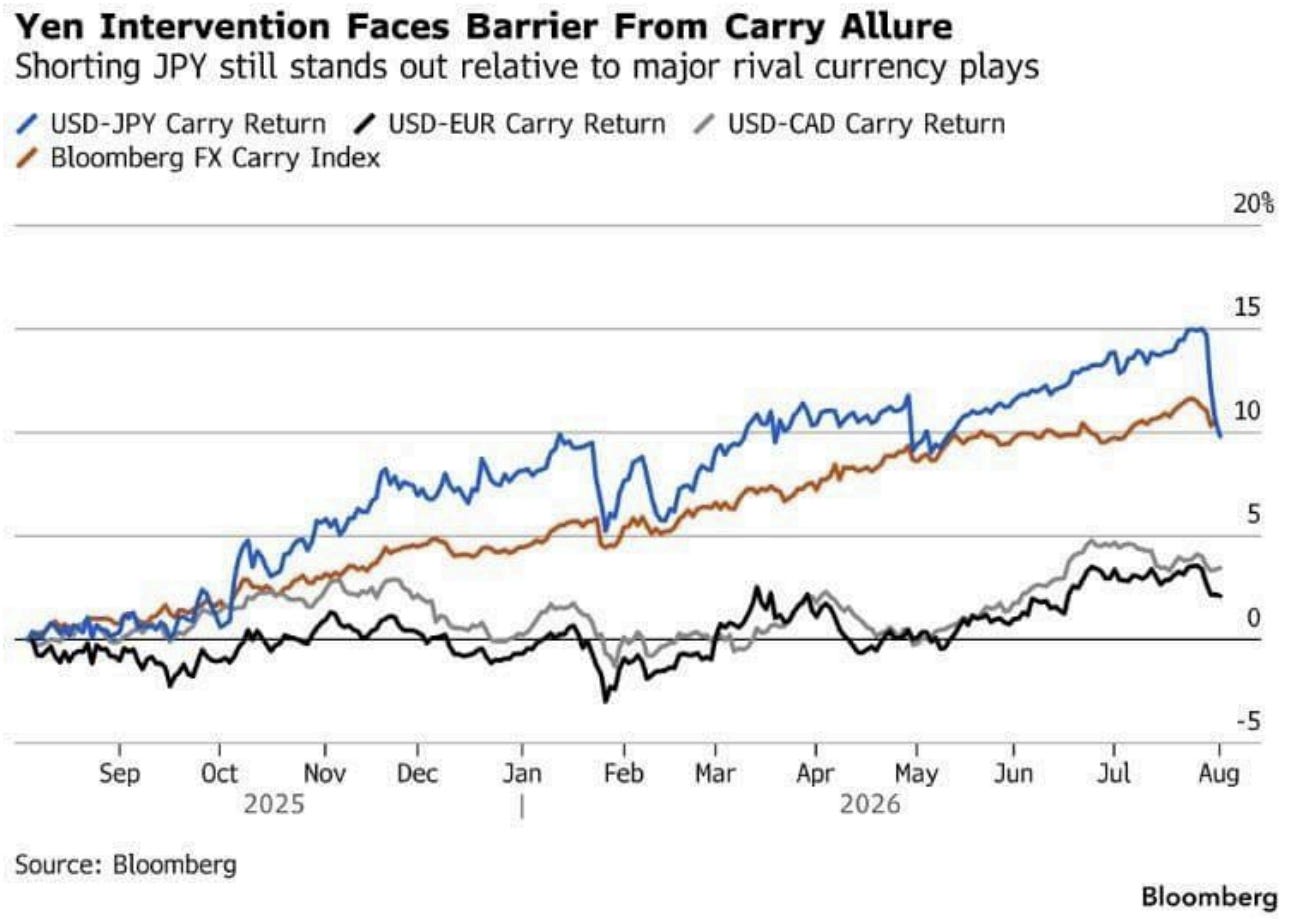
Since it’s a currency, it has to be taken in a pair against something else.
Traditionally shorting the Yen against a high-yielding currency such as AUD or NZD (when they were genuine high yielders) delivered decent profits because currency rates would routinely fail to converge to where forwards (dictated by interest rate differentials) say they should. This shouldn’t exist based on the theory of uncovered interest rate parity but in practice it does due to a required premium for the fat-tailed return profile of FX carry strategies.
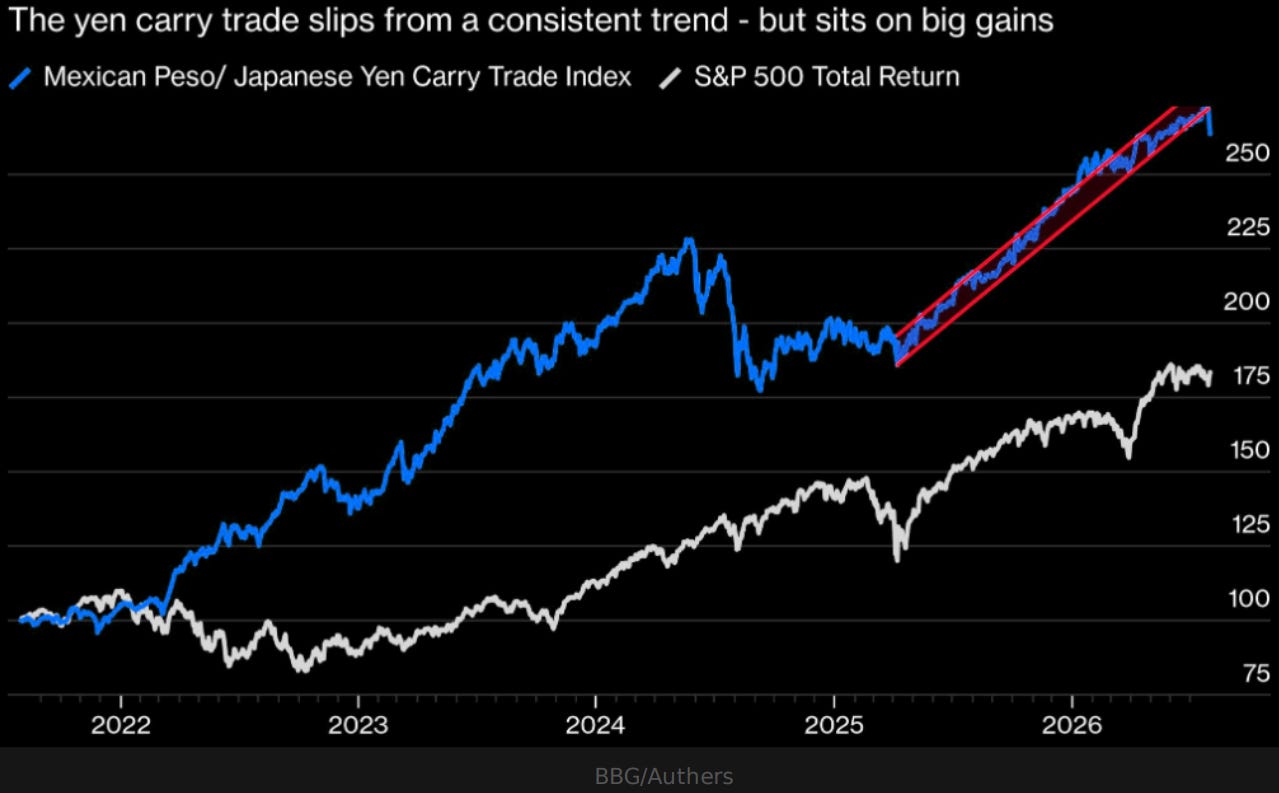
There have been many articles suggesting that the carry trade is strong because crosses like MXN/JPY (Mexican Peso/Japanese Yen) have outperformed the S&P500. Sure, but it also had a ~25% drawdown in 2024 with the side benefit of questionable liquidity in any decent size - ask any trading desk how easy it was to trade the Peso after Trump won in 2016.
They are always a little light on details as well. How much leverage? Did you need to post collateral or margin and what’s the cost of this? What is the risk-adjusted performance?
I don’t think the FX carry trade is anywhere as big as it used to be. The main reason is that it doesn’t exhibit the same downside sensitivity to risk as it did previously.
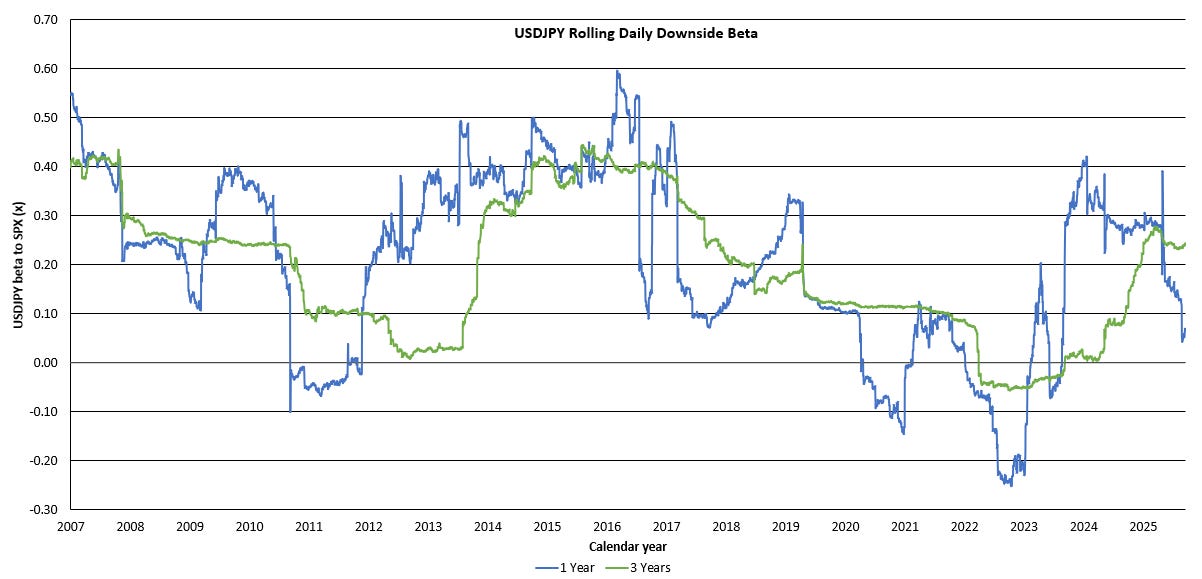
Above is a chart tracking how much USD/JPY moves relative to the S&P500 (chosen as a general risk proxy) over time. The early 2010s saw a much higher and persistent beta than recently, indicating that the carry trade was more popular as there was larger volume heading for the exit doors on a risk-off event. High rates have brought it back recently, but intervention seems to have put traders off again.
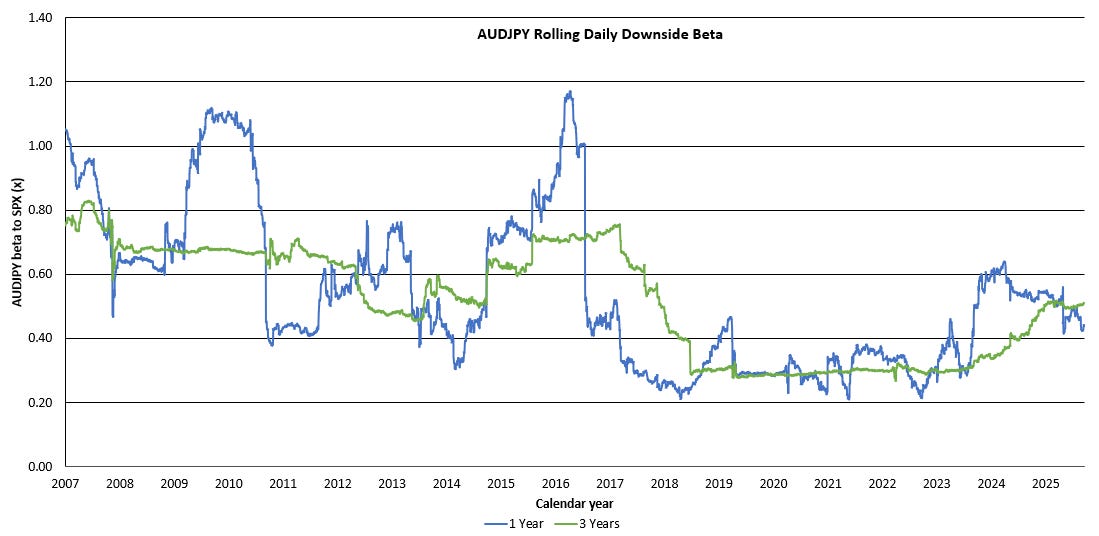
As rates rose across the developed world, interest in carry increased and downside beta ratcheted up. Another favourite, AUD/JPY, is well below past sensitivities to risk.
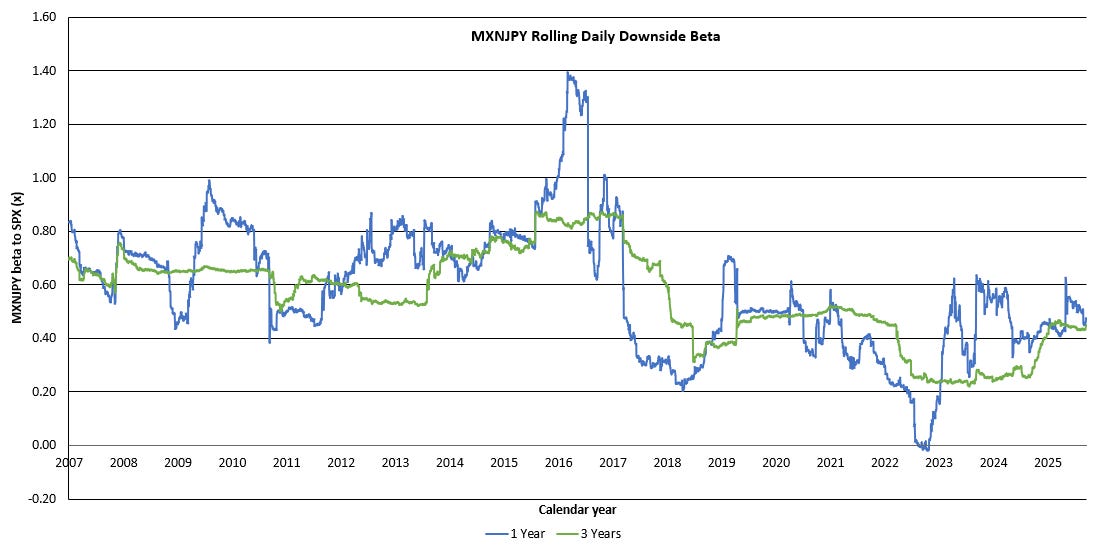
MXN/JPY exhibits the same trends, and this is despite Mexican interest rates being higher than they were in the early 2000s until recently.
As mentioned earlier, the “cost” of holding an FX carry position in your portfolio is the downside risk and potential liquidity issues. Therefore, intervention should raise volatility and the possibility of more volatility in the future.
Intervention should change volatility
The point of this type of intervention is to raise both current and expected volatility of the currency pair to stop the slow bleed of devaluation through the crowding of the carry trade.
This is unlike the more serious type of intervention where it is used to stop a crisis type situation. In this case it is used to quickly reduce volatility by temporarily setting a ceiling or floor.
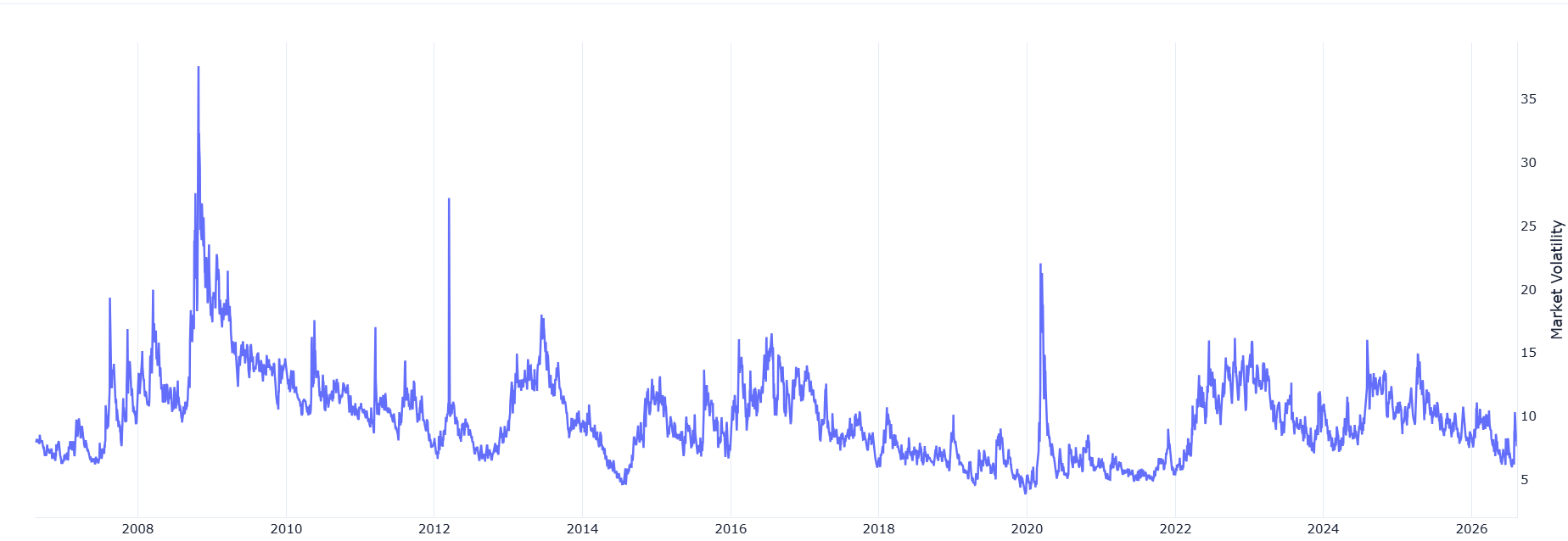
JPY implied volatility hit a new low in the post pandemic inflation era. This is fuel for carry traders which slowly push the currency lower. Volatility is the “discount factor” that goes into the expected profitability of these strategies. Higher expected volatility means that carry trading is less appealing.
Intervention to stop a crisis is the opposite. Generally, these types of trades will be negative carry (the first thing a central bank with a currency under attack would do is to raise rates quickly), so trades need volatility to pay for the negative carry. Killing volatility discourages this trader.
The worst mix is if you have positive carry and accelerating devaluation.
The acceleration risk
Bringing in the US to help with intervention isn’t because Japan is on the precipice of disaster, but actually the opposite. It’s all going a little too well.
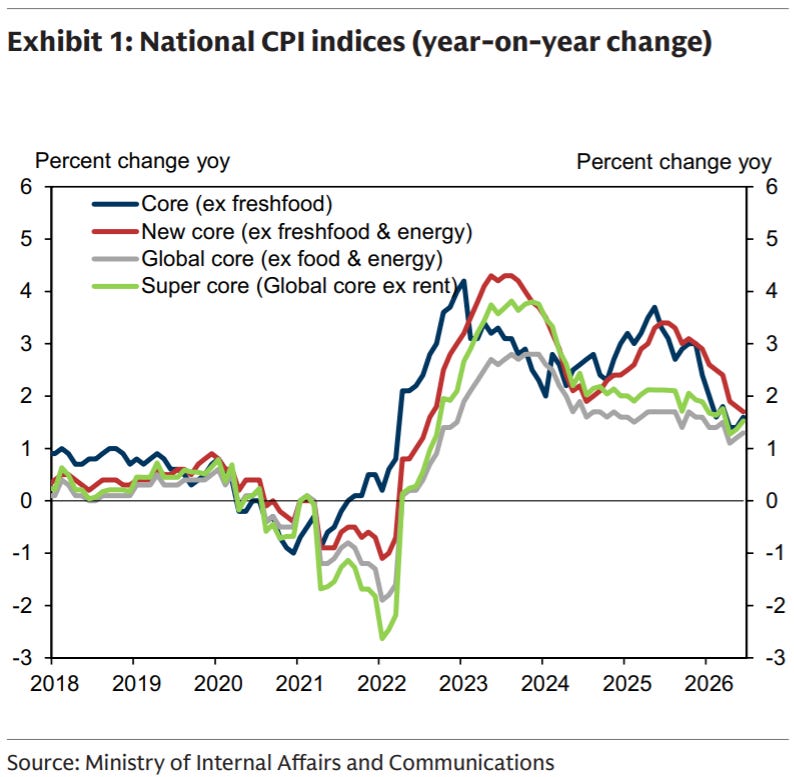
Japan has managed to lift itself out of deflation at a level that doesn’t look like it’s out of control. Most analysts have core CPI peaking just under 3% early next year and then tailing off after that. Not too bad considering what has happened to energy prices.
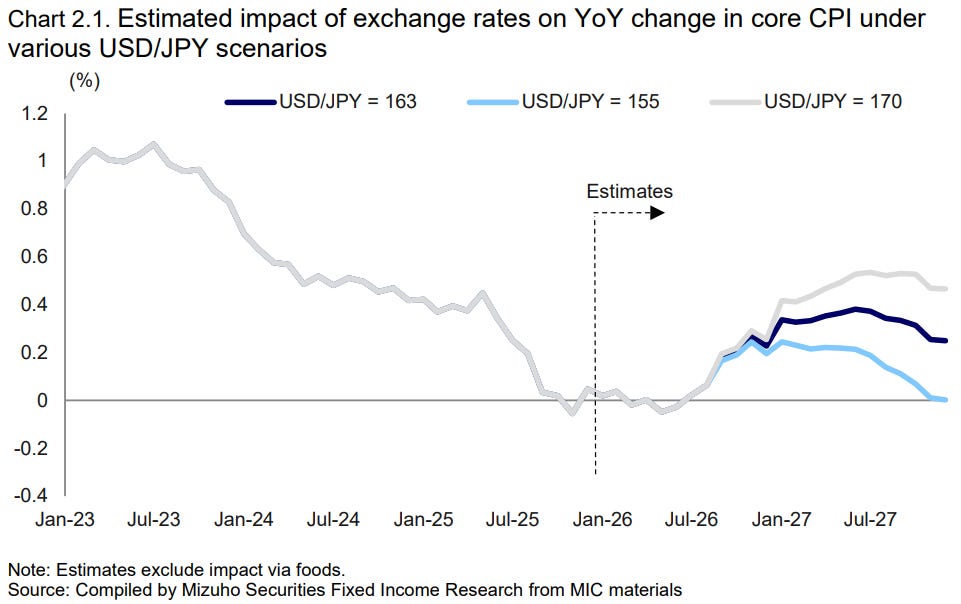
A higher USD/JPY can worsen this. Mizuho calculate the effects above, and they are quite large. Tolerating a higher USD/JPY can only happen until a certain point. After that it becomes more difficult to control.
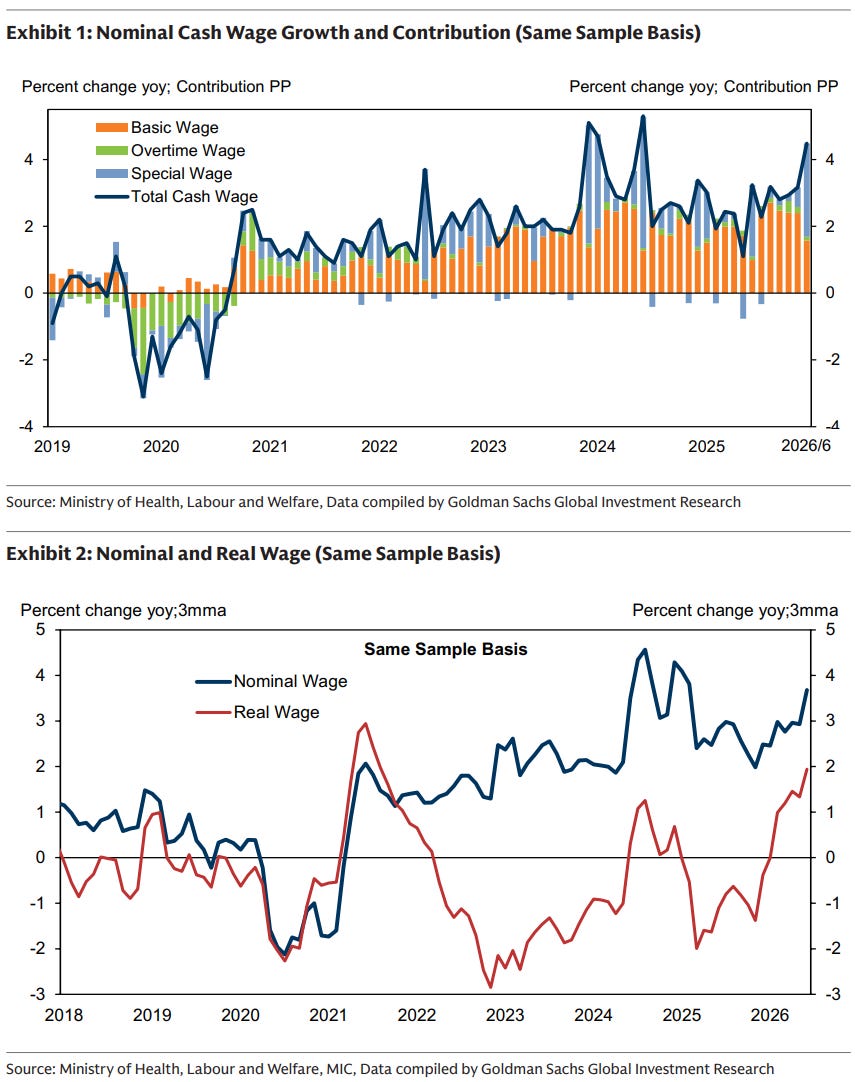
Wages look a little less compatible with a currency that would be comfortable staying around the 160 level.
Other growth indicators are pointing higher as well. This is all good news for a country that struggled for such a long time. It is understandable they don’t want to step on it by hiking too aggressively when intervention tools are available. There is a limit to this trade-off, however.
There is no crisis.
This is a growth and inflation versus rates and currency story.
What it isn’t is one about market instability or Japanese fiscal worries or someone selling US Treasuries to finance intervention causing issues.

Japanese fiscal discipline is far better than most western nations and has been from the pandemic onwards. Japanese government debt has lessened as share of GDP (through nominal GDP expansion) in addition to being more fiscally conservative. Declaring otherwise is a lazy and stale view on the Japanese fiscal positioning.
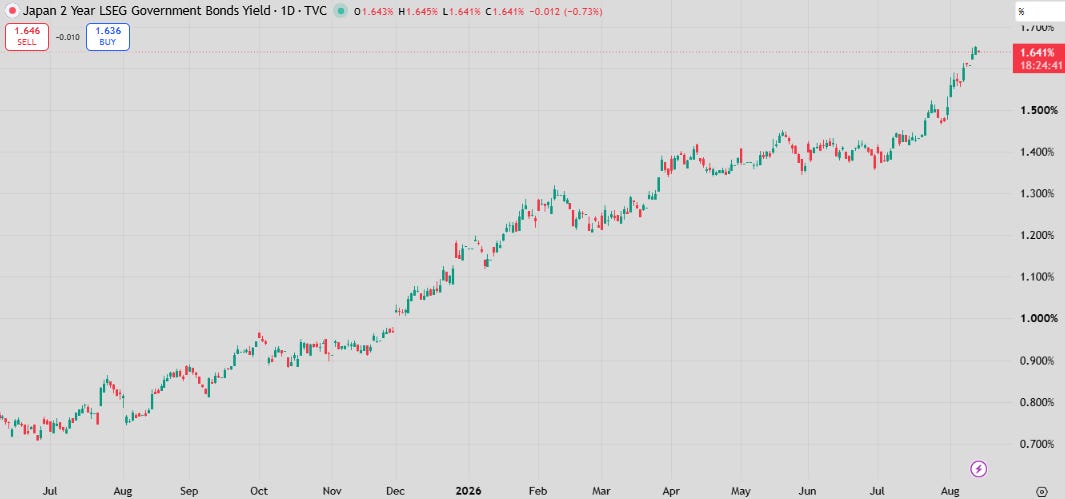
Japanese short rates could be hiked, and given the direction of 2-year rates, a hike in September are becoming more likely.
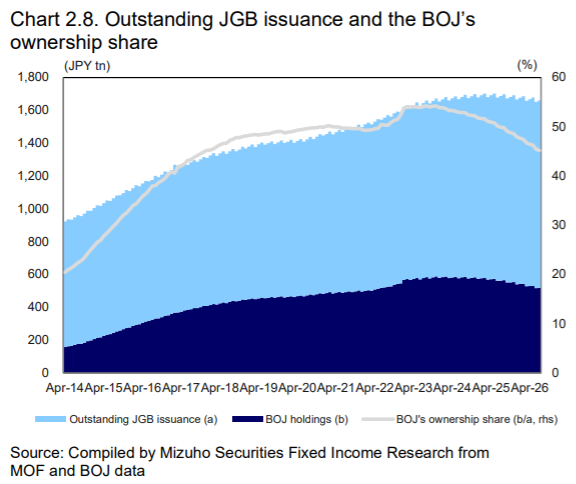
The BoJ continues to reduce holdings as well and could start buying again to contain long-end yields, yet it doesn’t. These are not signs of panic.
US intervention has been successful at setting a cap in the past without further spending. The threat of the firepower has been enough to dissuade Yen sellers. It might be successful again, but I suspect the BoJ will have to play along and raise rates a little faster than it wants to.
Wait is the argument that the Yen would depreciate more absent US intervention since the economy is strong, and that depreciation is not desired by the US since we want a weaker currency? Or do I have it all backwards
The "(JPY)" on the note made me laugh out loud.