

Another week, another intervention.
Like with the co-ordinated intervention in the Yen which I wrote about last time. Small size means that any of these interventions have a dubious effect on the underlying market from the actual bazooka dollars spent.
There has been a ton of garbage produced about this. The actual buyback itself isn’t that noteworthy. What is, is the signal and what it means for risk assets.
What the buyback isn’t
To get this out of the way at the start - increasing the size of off-the-run Treasury bonds from $2bn to $4bn isn’t Quantitative Easing (QE), nor is it Yield Curve Control (YCC).
The defining aspect of Quantitative Easing is the creation of bank reserves. This definition ensures that it is only a central bank (in this case, the Fed) who can conduct QE.
Why isn’t it YCC? Traditionally YCC is done by drawing a line in the sand and saying that “the government is a buyer of bonds at this yield and above”. If credible the government can control the bond yield without spending a cent. This is an effective capping of yields, which influences the shape of the yield curve.
The US Treasury has been conducting buybacks for a while now, with the aim being to increase liquidity by offering a bid in bonds that are “off-the-run” which have poorer liquidity than “on-the-run” bonds.
The next question is, of course, how is this paid for? You can’t buy more bonds without funding it somehow. This is where QE is different; the Fed can buy bonds by crediting the bank reserves of banks who engage in the transaction with them, essentially creating non-fungible “money” rather than borrowing or using equity like everyone else would have to.
The Treasury will pay for it by either:
Issuing more bonds or bills
Using cash reserves (kept in the Treasury General Account, or TGA, at the Fed)
Clearly issuing more bonds will reverse out any effect the buyback has on interpolated yields. Issuing bills could have an effect on the shape of the yield curve, perhaps.
Using cash seems like it would be the way to get yields down, right? No. That TGA account is at the Fed and is invested in…government bonds. So, you’d have to sell bonds to buy them. No go.
The signalling effect
There is little notable about the mechanism or size of the buyback, yet we got a big move in the dollar and other “safe haven” assets such as gold and Bitcoin.
While I have severe scepticism about anything related to narratives around gold and Bitcoin since their correlation to favoured narratives has swung so wildly over the last 12 months, the move in the US Dollar is a little more telling.
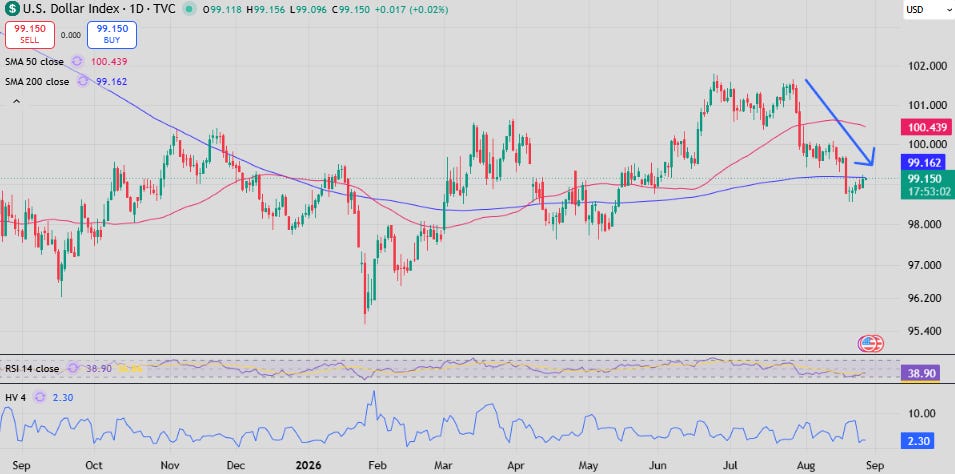
Even this may be related to captured positioning and an overbought market, which like gold and Bitcoin, was in dire need of a new narrative.
For now, the narratives of the “debasement trade” are strongest until they aren’t. If it was inflationary debasement, surely equities would be doing well over this whole episode, but they have struggled to make any impact this month after the gamma-led punch higher at the end of July.
The “debasement trade” is one that is always narrative explaining price rather than the other way around. Looking towards the interest rate swap market confirms that the announcements of larger size buybacks did have an effect.
Swap spreads
30-year swap spreads have moved steadily wider1 since the buyback announcement. This is the clearest evidence that it did indeed have a signalling effect, despite being limited in size.
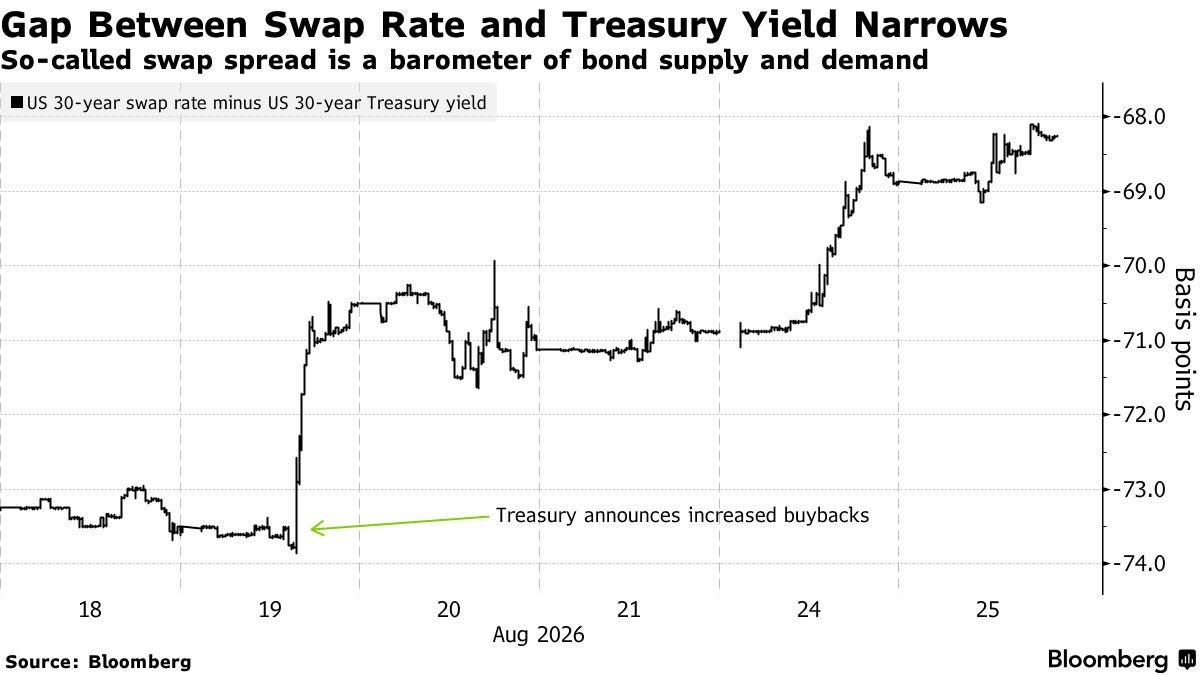
The swap spread is the difference between the yield on a matched US Treasury bond and the interest rate swap of the same tenor.
The swap spread historically was positive as it was seen that the risk of having a bank as counterparty on your swap trade (as the floating rate in the swap was LIBOR based and thus a rate that you were paid for lending to a bank) was greater than that of the government.
This has changed. Part of it was moving to SOFR, a rate that wasn’t linked to short-term lending to banks anymore. As the comparison is a funded versus unfunded asset (you need to deploy capital to buy a Treasury bond where swap only needs margin as capital), changes in the cost of capital for holding a Treasury bond changes the relationship. This effect of this has mutated with multiple regulatory changes over the years. If you have any particular interest in the technical intricacies of this market, you have to follow the one-and-only Conks!
The move in the swap spread chart above is significant and shows that the market is treating Bessent’s interventions as credible.
To be fair, after achieving what they did in crude oil markets over the war probably deserves that respect elsewhere.
It’s always about more debt
Most have pointed to the rally in precious metals as the intervention trade. If that was the case, we would’ve never had a drawdown at all this year as intervention has done nothing but ratchet up all year.
The Dollar is still range trading and has little informational value here.
It’s equities that should be the main beneficiary, along with other money-supply risk assets that are similar. This includes gold.
This may seem contradictory. I say that gold doesn’t benefit from interventionism but then say that it does. The difference is that it is not worry about interventionism (i.e. the idea that debasement makes any sense at all), it is the signal that if they are willing to intervene at such a non-consequential juncture that infers that another burst of debt will come if something much more serious occurred.
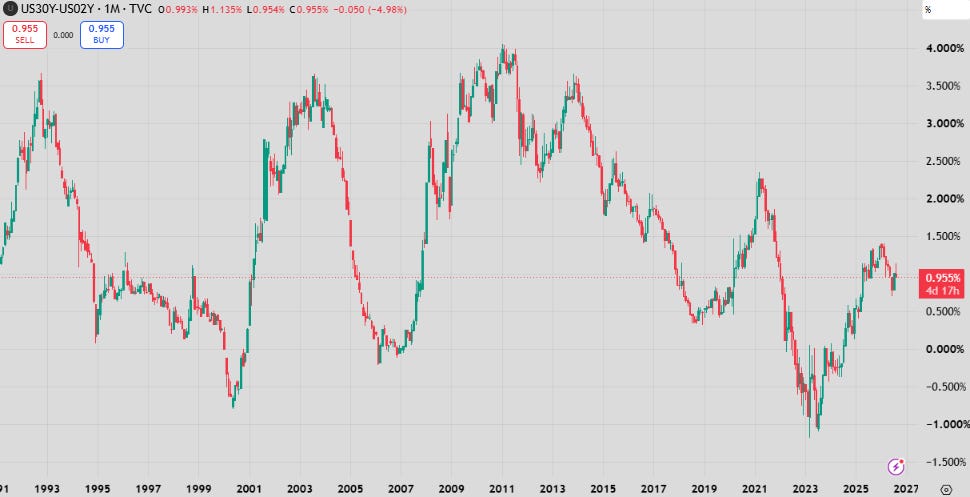
There is nothing worrisome about the 30-year at 5.3%. The curve isn’t even historically steep, and nominal GDP growth is probably running at 6%+. This is where it should be, if not higher!
Worry about a 5.3% yield is driven entirely by how media writes about it. Before the intervention, headlines about a bond market out of control were everywhere. Garbage reporting, but it makes politicians worry.
Now, can you imagine how it would be if equities were down 30%?
There can be no question that the government will spend what it needs to keep things how they are. This will survive this government into the next. COVID destroyed that barrier, and we aren’t going back.
Bonds don’t benefit from this. In fact, they have the opposite reaction. It is risk assets like equities the doubly benefit from more government spending from revenue growth (the churn of money) and pricier valuations (the volume of money).
Gold doesn’t have the double benefit, so it will lag. But it is sensitive to the volume of money, and that will propel it higher. Offsetting this somewhat is the threat of higher real yield which diminishes the relative value of gold. This won’t be relevant if Bessent deploys even more tactics to keep long yields down.
Yes, it’s wider despite getting “tighter” in absolute spread. Wider just means that swaps are getting cheaper to bonds, since swap spreads were normally always positive once upon a time!
The TGA is invested in bonds? How does that work??
Bessent will force private banks to buy more treasuries...no other chance. And also stablecoins have to buy. That's the plan